Try this: stop reading for ten seconds and just listen to your office. Keyboards clicking, a call two desks away, a chair scraping, laughter from the pantry. How much of your best thinking happens through that?
A 2018 Oxford Economics study, commissioned by Plantronics, found that 63% of employees lack quiet space for focused work, while only 6% of executives had equipped their offices with noise-mitigating features. Closing that gap is what smart office acoustic design is for.
Why Noise Matters:
Distraction breaks concentration, and recovery takes time. UC Irvine researcher Gloria Mark found workers took about 23 minutes on average to return to a task after an interruption. That covers interruptions of all kinds, but noisy open floors make them more frequent.
Absorb, Block, Mask:
Effective office noise reduction solutions combine three strategies: absorb echo with soft surfaces, block transmission with sealed partitions and doors, and mask distant speech with gentle background sound.
Practical Fixes:
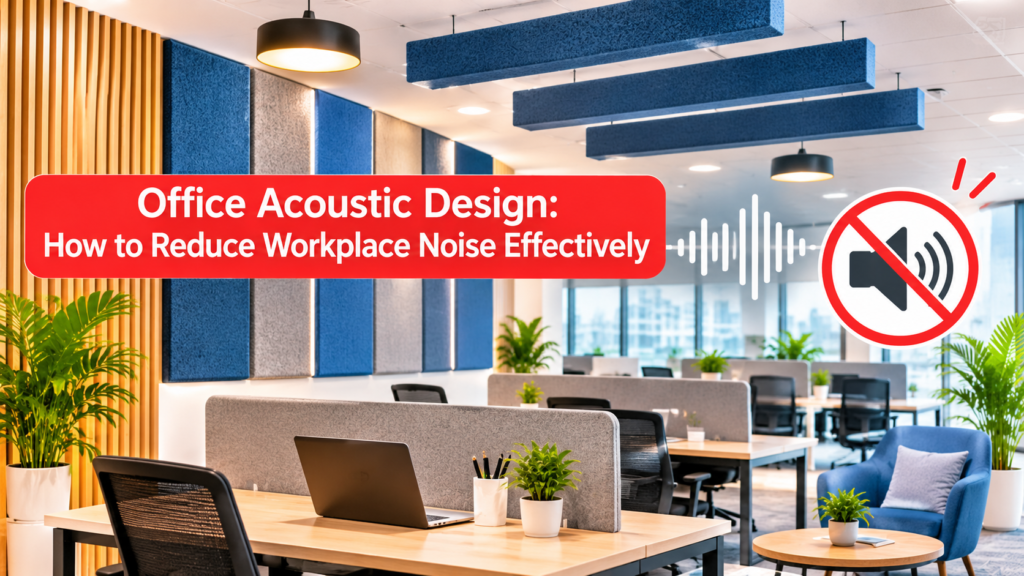
Acoustic panels for offices are the most visible fix; ask for each product’s NRC (Noise Reduction Coefficient) rating. Add phone booths for calls, carpet, and soft furnishings to cut echo, and full-height partitions for meeting rooms. Good corporate office acoustic design is planned alongside lighting and HVAC, and our guide to designing offices that improve collaboration shows how to balance noisy and quiet zones.
| Solution | What It Does | Best For |
| Acoustic wall/ceiling panels | Absorb echo | Open-plan floors, meeting rooms |
| Full-height partitions | Block sound | Meeting rooms, cabins |
| Phone booths | Contain calls | Open workspaces |
| Carpet and soft furnishings | Reduce impact noise | Corridors, lounges |
| Sound masking | Reduces speech clarity | Large open areas |
Acoustics Across Bengaluru:
Each area has its own challenge:
- Whitefield: large floor plates make office acoustic design in Whitefield about controlling echo.
- Hebbal: traffic and flight-path noise means commercial interiors in Hebbal need well-sealed façades and doors.
- HSR Layout: compact floors suit office acoustic solutions in HSR Layout built around multi-purpose booths.
- Yelahanka: teams planning office interior design in Yelahanka can build zoning in from day one.
- Indiranagar: creative studios want acoustic office interiors in Indiranagar that look as good as they sound.
- Koramangala: busy surroundings make office noise control in Koramangala vital for meeting rooms.
- Electronic City: call-heavy teams need IT office acoustic design in Electronic City that isolates voice work.
- Sarjapur: new campuses can build office acoustics in Sarjapur into the base design.
- Marathahalli: retrofits often rely on office acoustic panels in Marathahalli for a quick, affordable upgrade.
Plan Acoustics into the Build:
Acoustics are cheapest to get right before ceilings close up. Ask for the STC (Sound Transmission Class) rating of meeting-room walls, and check gaps around doors and partition tops during execution. Our article on quality control during commercial interior execution explains how.
When comparing office soundproofing solutions in Bengaluru, request data sheets and photos of completed work. Sree Craft, for example, produces custom furniture and joinery in its own factory, and the benefits of a turnkey approach are covered in a separate guide.
Final Thoughts:
Start by listening, as you did at the top. Find where noise hurts focus, then absorb, block, and mask zone by zone. When you’re ready to plan a fit-out, you can reach the Sree Craft team through their contact page.
Frequently Asked Questions:
1.What is the difference between soundproofing and acoustic treatment?
Soundproofing blocks sound between spaces; acoustic treatment absorbs echo within one. Most offices need both.
2. How can I reduce noise in an open-plan office?
Add panels, quiet zones, phone booths, and soft flooring, and consider sound masking.
3. Do acoustic panels really work?
Yes, they reduce echo, but they don’t block sound between rooms. Pair them with solid partitions.
4. Is acoustic planning worth it for a small office?
Yes. Soft furnishings, a quiet corner, and one call booth can noticeably improve focus.
Sources:
- Oxford Economics (commissioned by Plantronics), 2018 workplace noise study.
- Mark, G., Gonzalez, V., & Harris, J. (2005). “No task left behind?” CHI 2005; Gallup Q&A with Gloria Mark.